From Signals to Decisions: Why Information Integrity Determines Growth
July 26, 2026 · Sangmin Lee · 9 min read
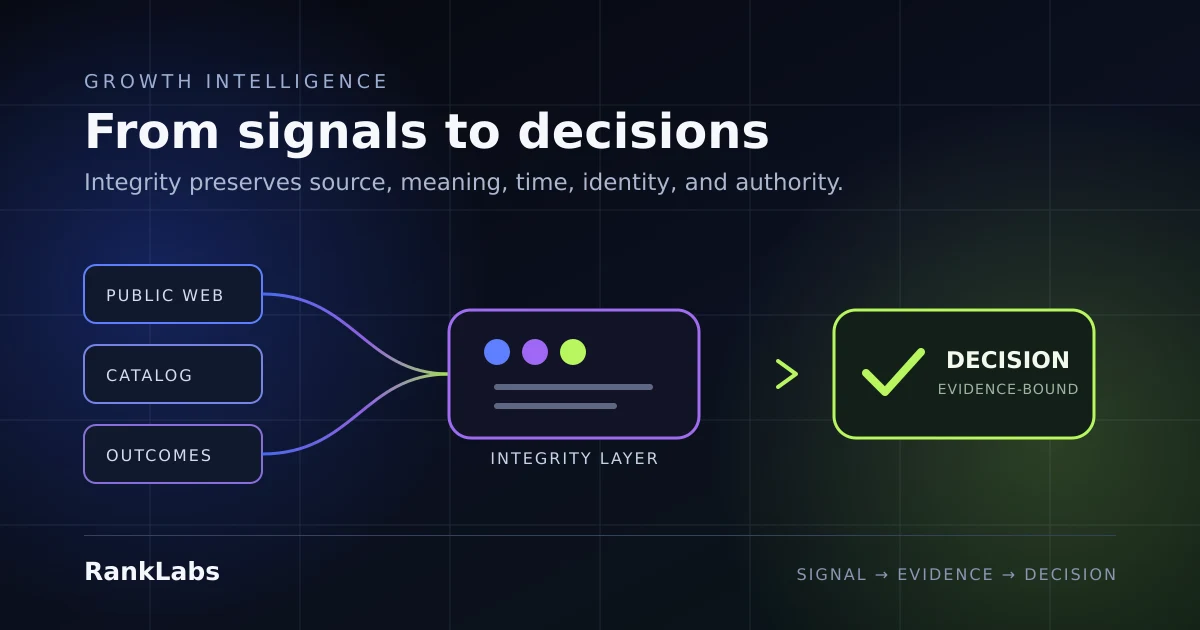
Short answer
A company asks why ChatGPT stopped recommending its product.
Marketing blames content. Engineering blames rendering. Analytics says nothing changed. Sales says pipeline dropped anyway.
Everyone has data. Nobody has the same evidence.
That is not an AI problem. It is an information integrity problem.
Information does not create growth by itself. Its integrity determines whether a growth system can distinguish an observed fact from an inference, a recommendation from an action, and an outcome from an attribution claim.
A dashboard can contain thousands of current-looking numbers and still be unreliable. If those numbers have unclear sources, conflicting identities, mismatched time windows, or hidden missing data, faster analysis only produces faster mistakes.
Information integrity is the ability to preserve what a signal means, where it came from, which entity and period it describes, how it changed, and what it can legitimately support.
That is what turns signals into defensible decisions.
Current RankLabs boundary: RankLabs supports public-web and enabled AI-provider observations, deterministic diagnostics, evidence-linked findings, and governed recommendations within supported scope. Connected evidence contributes only when its source, authorization, and coverage are established. Customer activation and autonomous external execution are not currently announced as available.
More signals do not guarantee better decisions
Growth teams work across many representations of the same business:
- public pages and structured data;
- product and service catalogs;
- search and AI-provider observations;
- analytics and advertising platforms;
- CRM and lifecycle systems;
- commerce, billing, and payment records;
- experiments, tasks, approvals, and action logs.
These systems rarely use identical identities, timestamps, definitions, or update schedules. “Revenue” may mean gross sales in one system, collected payments in another, and modeled conversion value in a third. A product may appear under a SKU, URL, platform ID, campaign label, and free-text name.
Combining those values without preserving their meaning does not create intelligence. It creates a cleaner-looking contradiction.
The Automated Growth Intelligence operating model therefore begins with evidence rather than automation:
Observe → Resolve → Explain → Decide → Act → Learn → Govern
Every stage depends on the integrity of the information passed into it.
A signal is not yet evidence for a decision
A signal is a stored observation from a defined source. It becomes useful decision evidence only when its contract is clear.
| Integrity field | Question it answers |
|---|---|
| Source | Which system, document, page, provider, or operator produced it? |
| Entity | Which organization, product, page, campaign, customer group, or other object does it describe? |
| Observed time | When did the represented state exist or become observable? |
| Retrieved time | When did the system acquire it? |
| Scope | Which tenant, market, locale, cohort, provider, or query does it cover? |
| Meaning | What exact measure, state, or claim does the value represent? |
| Lineage | Which raw evidence, transformation, and version produced it? |
| Availability | Is the value observed, unavailable, unsupported, stale, failed, or unknown? |
Without these fields, a value may be displayable but not decision-ready.
The six tests of information integrity
1. Source authority
A source must have authority for the claim being made.
A public product page can establish what the site displayed when it was fetched. It cannot establish collected revenue. An analytics event can report attributed conversion value under that platform's model. It cannot automatically establish cash received or causal lift.
Source authority is claim-specific. A connected system is not authoritative for every question.
2. Identity resolution
Signals must resolve to stable entities without pretending uncertain matches are exact.
A catalog product, public URL, ad destination, CRM opportunity, and invoice line may refer to the same commercial offering. They may also represent different variants, bundles, regions, or historical versions.
Resolution should preserve exact matches, inferred matches, unresolved candidates, and contradictions separately. Silent merging can assign one product's cost, status, or outcome to another.
3. Temporal alignment
Observation time, retrieval time, effective time, and reporting window are different.
A page fetched today may display inventory updated yesterday. A monthly analytics report may contain late-arriving events. A recommendation approved last week may refer to content that changed this morning.
Comparisons require compatible periods and freshness rules. Current-looking values should not conceal stale evidence.
4. Semantic consistency
Shared labels do not guarantee shared meaning.
Revenue, sales, pipeline, bookings, billings, collections, margin, and conversion value are not interchangeable. Neither are impression, appearance, citation, recommendation, and click.
A system should retain provider and measure identity instead of forcing distinct concepts into one generic metric.
5. Completeness and missingness
Missing evidence is information.
A source may be disconnected, a field may be unsupported, a crawl may fail, a provider may return no citation, or a reporting period may be incomplete. Each state has a different interpretation.
Replacing these states with zero can turn “not observed” into “nothing happened.” Dropping them can make partial coverage appear complete.
6. Version and transformation lineage
Decision evidence changes as sources update and transformations evolve.
The system should preserve the raw observation, extraction or calculation version, normalization steps, and later corrections. A decision must remain linked to the evidence version reviewed at the time, not silently inherit whatever the source says today.
Resolve contradictions before scoring opportunities
Consider a product with four simultaneous signals:
- The approved catalog says it is available.
- The public page says it is unavailable.
- An advertising campaign continues sending traffic to the page.
- A stored AI answer describes it as available.
These signals do not prove which representation is correct or what commercial impact followed. They establish a contradiction that needs resolution.
A trustworthy system should preserve all four observations, identify their source and time, resolve them to the same product where supported, and explain what remains unknown. It should not select the most convenient value merely to produce one status.
Only then can it form a finding such as:
The public availability representation conflicts with the approved catalog observation captured within the defined comparison window.
That finding can support a recommendation. It still does not prove that a change was approved, executed, or commercially effective.
Keep the decision chain navigable
Information integrity must survive beyond observation. The complete chain is:
Signal → Resolved entity → Finding → Recommendation → Decision → Action attempt → Verification → Outcome observation
Each record answers a different question:
- What was observed?
- What did it refer to?
- What issue or opportunity was supported?
- What response was proposed?
- What authority approved or rejected it?
- What operation was attempted?
- What resulting state was verified?
- What outcome was later measured?
The governance layer for growth automation depends on this separation. If a platform collapses recommendations, actions, and outcomes, it cannot reliably explain what happened.
Decision quality requires visible uncertainty
A decision can be reasonable without complete information. The requirement is not perfect certainty. It is visible uncertainty.
A decision record should preserve:
- evidence coverage;
- known contradictions;
- unavailable dimensions;
- confidence type and basis;
- assumptions;
- alternative explanations;
- expiration or reevaluation conditions.
This allows a reviewer to distinguish “supported within limited scope” from “universally true.” It also prevents new evidence from making an old decision appear better informed than it was.
Integrity determines what can be measured
An outcome should connect to an identifiable intervention, affected population, source, measure, comparison method, and observation window.
If the intervention is not recorded, a later change cannot be assigned to it. If the outcome source is unclear, the measure cannot be interpreted. If populations or windows differ, the comparison may be invalid.
AI answer volatility illustrates this principle for comparable provider observations. AI Revenue Intelligence applies it to commercial evidence and attribution boundaries. Both are examples of a broader rule: measurement quality cannot exceed information integrity.
Operational checks for growth information
Teams can evaluate integrity before relying on a report or automated workflow:
- Can every material value be traced to a source and retrieval time?
- Are entity matches exact, inferred, unresolved, or contradicted?
- Do compared values represent compatible periods and scopes?
- Are similarly named measures kept semantically distinct?
- Are unavailable, stale, failed, unsupported, and zero distinguishable?
- Can the evidence version behind a decision be reconstructed?
- Are recommendation, approval, action, verification, and outcome separate records?
- Does the claim stop where source authority stops?
If the answer to any question is no, the system should narrow the claim or request more evidence before acting.
What this means for RankLabs today
RankLabs is building Automated Growth Intelligence around an evidence-first contract.
Its available foundation can capture public-web evidence through RankLabsBot, preserve enabled AI-provider observations, synchronize supported organization-scoped catalog facts, run deterministic diagnostics, and organize evidence-linked findings and recommendations.
Those channels remain distinct. A public-web fetch does not prove provider behavior. An AI appearance does not prove revenue. A catalog connection does not establish payment evidence. A recommendation does not establish action authority.
The broader platform direction is to connect supported signals to governed decisions, approved actions, and measurable learning without erasing the boundaries between them. Availability remains source-, tenant-, and activation-dependent.
Frequently asked questions
What is information integrity in a growth system?
It is the preservation of source, identity, time, scope, meaning, lineage, and availability so each signal can support only the claims and decisions its evidence allows.
Is information integrity the same as data accuracy?
No. Accuracy asks whether a value is correct. Integrity also asks what the value means, where it came from, what it describes, when it applied, how it changed, and whether missing evidence is visible.
Why not combine every growth metric into one score?
A single score can hide incompatible meanings, sources, periods, and coverage. Aggregation is useful only when its inputs, weights, limitations, and unavailable dimensions remain inspectable.
Does more connected data produce better decisions?
Not automatically. More sources can introduce identity conflicts, semantic differences, stale values, and duplicate evidence. Decision quality improves only when those differences are resolved or preserved as uncertainty.
Does information integrity prove that a decision caused growth?
No. It makes the evidence chain inspectable. Causal claims still require an identifiable intervention, valid outcome source, comparison strategy, observation window, and assessment of alternative explanations.
The practical conclusion
Growth systems do not become intelligent by collecting the most signals. They become useful by preserving what each signal can and cannot prove.
Information integrity determines whether a system can move from observation to decision without losing meaning, authority, or accountability.
When integrity is preserved, teams can act with visible evidence and learn from identifiable interventions. When it is not, automation scales ambiguity.