What Is Automated Growth Intelligence?
July 26, 2026 · Sangmin Lee
Short answer
Automated Growth Intelligence turns trusted observations into governed growth decisions. It connects what happened, what the evidence supports, what action was approved, and what outcome followed without treating visibility as revenue or correlation as causation.
In this article, AGI means Automated Growth Intelligence, not Artificial General Intelligence.
Available foundation: RankLabs currently supports public-web and enabled AI-provider observation, deterministic diagnostics, evidence-linked findings, and governed recommendations within supported scope.
Platform direction: Cross-source decisions, approved actions, experiments, and outcome learning. Customer activation remains subject to separate authority. Autonomous external execution and customer-ready revenue attribution are not announced as available.
The problem in one scenario
A brand disappears from a stored AI answer. A competitor appears instead. The site changed the same week, campaign spend increased, and revenue moved.
Which event matters? Which evidence can be trusted? What should the team do next?
Most growth stacks can display pieces of that story. Analytics reports traffic. Advertising platforms report spend. CRM and billing systems report different forms of commercial activity. AI visibility tools report mentions, omissions, or citations.
The failure happens between those systems.
Teams still need to determine:
- whether the observations describe the same company, offering, population, and time window;
- what the evidence supports and what remains unknown;
- whether a recommendation was approved and executed;
- whether an outcome can be connected to that intervention;
- who had authority to act and how the action could be reversed.
That is the problem Automated Growth Intelligence is designed to address.
A practical definition
Automated Growth Intelligence is a governed operating model that connects trusted observations to decisions, approved actions, and measurable learning while preserving evidence and approval at every stage.
The phrase has three parts:
- Automated means repeatable work can move through explicit policies and controls. It does not mean unsupervised action.
- Growth means the system is oriented toward business improvement, not only reporting or visibility.
- Intelligence means findings remain connected to their sources, scope, confidence, limits, and outcome evidence.
The operating loop is:
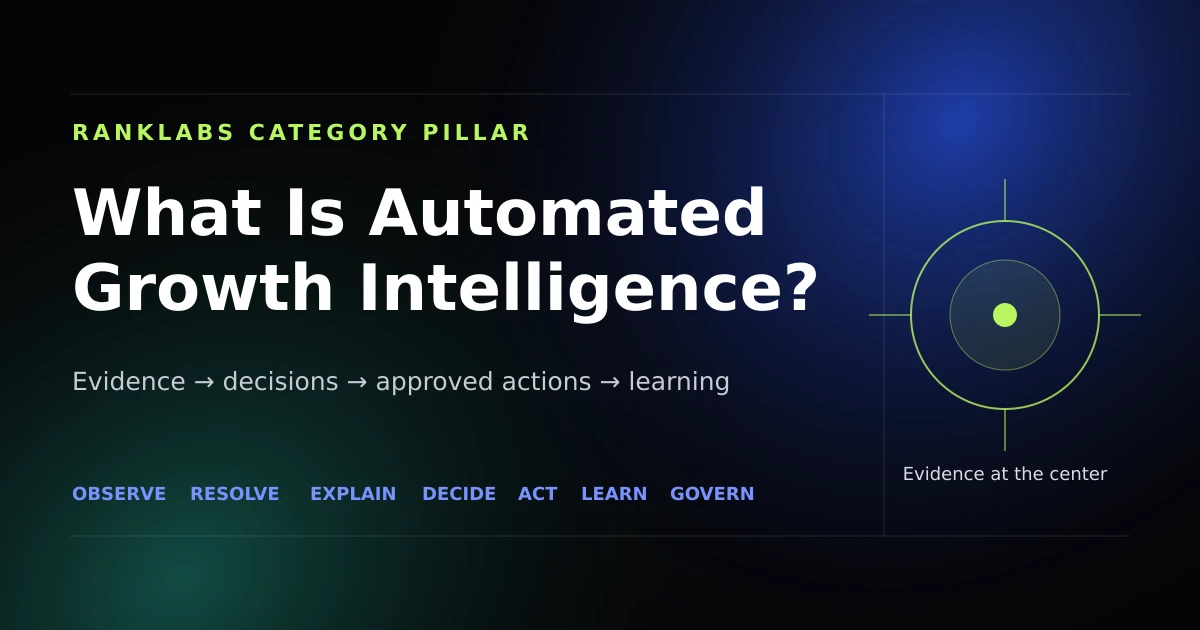
Observe → Resolve → Explain → Decide → Act → Learn → Govern
| Stage | Core question | Required record | RankLabs status |
|---|---|---|---|
| Observe | What happened? | Exact source observation | Available within supported scope |
| Resolve | What belongs together? | Versioned identity and relationship evidence | Foundational and scope-dependent |
| Explain | What does the evidence support? | Finding, confidence, limits, and contradictions | Foundational and scope-dependent |
| Decide | What should be approved? | Recommendation and human decision | Staged |
| Act | What changed externally? | Authorized, bounded, reversible action record | Customer activation withheld |
| Learn | Did the action affect the outcome? | Intervention, comparison, outcome, and time-window evidence | Planned and evidence-dependent |
| Govern | Was every stage allowed and inspectable? | Policy, tenant, cost, approval, and rollback evidence | Foundational design requirement |
A company can adopt this model before every stage is automated. Evidence and approval should exist before execution.
A hypothetical walkthrough
Return to the brand that disappeared from a stored answer. This is a hypothetical example, not a customer result.
- Observe: Store the exact answer, prompt, citations, provider context, crawl evidence, and observation time.
- Resolve: Match the organization, offering, page, and observed competitor to versioned identities.
- Explain: Show the answer difference, available site gaps, source coverage, contradictions, and unknown causes.
- Decide: Review one bounded recommendation and record whether a person approved it.
- Act: If separately authorized, preserve the exact external change, before state, and rollback path.
- Learn: Compare the defined outcome population and window without assuming the action caused every difference.
- Govern: Preserve tenant scope, source permissions, cost, approval, and publication limits throughout the loop.
The value is not that every stage runs without people. The value is that information does not lose its meaning as it moves from observation to action.
Observe: preserve the original event
Observation should preserve more than a summarized score.
For AI-mediated discovery, that can include the exact prompt, stored answer, citations, provider context, observation time, and run lineage.
Public-web evidence is a different source type. It can include requested and final URLs, response status, redirects, bounded raw HTML, metadata, canonical references, structured data, internal links, and validation issues.
RankLabs uses RankLabsBot for deterministic first-party public-web acquisition. A RankLabsBot fetch proves what RankLabs retrieved. It does not prove that an AI provider fetched, indexed, cited, or used the page. Provider behavior requires its own stored observation.
Commercial evidence is different again. Sales, billings, collections, recognized revenue, pipeline, margin, and provider-reported conversion value are not interchangeable. They contribute only when an approved source is explicitly connected and validated.
Resolve: establish identity before aggregation
A product page, catalog record, ad item, invoice line, and AI answer may refer to the same offering in different ways. An organization may have multiple sites, locations, brands, and domains.
Resolve makes those relationships explicit:
- Which organization or offering is this?
- Which source asserted the relationship?
- At what time was it true?
- Is the match deterministic, approved, inferred, contradicted, or unknown?
Structured data and canonical identity matter here, but they are not the entire category. They are evidence used to resolve entities inside a larger growth system.
Explain: show the finding and its limits
A defensible explanation preserves supporting evidence, assessed coverage, confidence, contradictions, unavailable dimensions, alternative explanations, and the next check that could reduce uncertainty.
If a brand disappears while a competitor appears, RankLabs may be able to show that:
- the answer changed between comparable runs;
- the competitor appeared in the later answer;
- a cited page changed;
- structured evidence was missing or inconsistent;
- provider or source coverage was incomplete.
Those facts can support a diagnosis or recommendation. They do not prove that one gap caused the provider to omit the brand. Cause requires intervention and outcome evidence.
Decide and Act: separate a proposal from a change
A recommendation is not an action.
A decision record should preserve the recommendation, evidence version, expected benefit, uncertainty, risk, dependencies, approval, and measurement requirement.
Presence Manager reflects this separation. View supports inspection of observations. Manage organizes evidence-backed recommendations and their limits. Manage does not imply that an external change occurred.
The Act stage begins only when a system can affect the outside world. Every action then needs explicit scope, policy checks, duplicate protection, a before state, a rollback path, and an immutable action record.
Automation without those controls is ungoverned execution.
Learn: measure without manufacturing causality
Learning begins only after the intervention is identifiable.
A credible learning record needs a specific treatment, an affected population, a comparison strategy, an exact outcome source, a predefined observation window, known confounders, and a reproducible method.
A before-and-after difference is not automatically an experiment.
If an AI answer changes after a page update, the update may be associated with the change. The provider model, retrieval corpus, prompt handling, competing sources, or normal output variance may also have changed.
The system should say what the evidence supports, not promote an association into a causal result because the stronger claim sounds better.
Govern: protect the whole loop
Governance surrounds every stage. It determines which sources are allowed, which tenant can access evidence, which costs are acceptable, which findings can be published, which actions require approval, how evidence is retained, and when an action must stop or roll back.
A governed system can say "not available," "not measured," "withheld," or "unknown" without turning those states into estimates.
Those states protect evidence integrity.
Where AEO, GEO, AI visibility, and Revenue Intelligence fit
Automated Growth Intelligence does not eliminate existing disciplines. It places them in a clearer hierarchy.
AEO and GEO
Answer Engine Optimization and Generative Engine Optimization describe strategies for participating in AI-mediated discovery. They sit primarily across Observe, Resolve, and Explain. They are channels and practices, not the entire company category.
AI visibility
AI visibility is an observation signal. It can show appearances, omissions, citations, answer differences, and competitor presence within a defined observation set.
It cannot, by itself, establish revenue, purchase influence, provider intent, or causal impact. See What Are You Really Measuring When You Track AI Visibility? for a deeper treatment.
Revenue Intelligence
Revenue Intelligence is a source-dependent internal layer. It becomes meaningful only when exact commercial measures, source contracts, identity mappings, and observation windows exist.
Revenue is not a synonym for visibility. It is not safe to estimate merely because an AI answer changed.
What Automated Growth Intelligence is not
It is not:
- a new name for an AI visibility dashboard;
- an autonomous marketing agent with unlimited permission;
- a promise that every recommendation will improve revenue;
- a causal engine built from before-and-after screenshots;
- a universal integration claim;
- a replacement for human accountability;
- Artificial General Intelligence.
It is a disciplined way to connect evidence, decisions, actions, and learning without losing the boundaries between them.
How to evaluate a platform
Ask these questions:
- Can every finding link to exact source evidence?
- Does the system distinguish public-web crawling from provider behavior?
- Are unavailable and contradictory states visible?
- Are recommendations separate from decisions and actions?
- Does every external action require explicit approval?
- Can actions be bounded, audited, and rolled back?
- Are commercial measures tied to exact source definitions?
- Does causal language require intervention and outcome evidence?
- Are tenant, credential, cost, and retention policies enforceable?
- Does the platform state what is available now versus planned?
If those answers are unclear, the system may automate activity without producing trustworthy intelligence.
Frequently asked questions
Is Automated Growth Intelligence the same as Artificial General Intelligence?
No. In RankLabs content, AGI means Automated Growth Intelligence. It is a governed growth operating model, not a claim about human-level general machine intelligence.
How is Automated Growth Intelligence different from AI visibility?
AI visibility is one observation signal inside the broader loop. Automated Growth Intelligence connects observations to resolved identity, supported explanation, decisions, approved actions, measurable learning, and governance.
Does automated mean autonomous?
No. Repeatable work can be automated while external actions still require explicit scope, approval, policy checks, and rollback controls.
What does RankLabs support today?
RankLabs supports the evidence, observation, diagnostic, and governed-recommendation foundation within supported scope. Cross-source commercial intelligence, customer actions, experiments, and outcome learning require additional source, policy, activation, and measurement approval.
The RankLabs direction
RankLabs is building toward the complete operating loop.
The available foundation starts with deterministic public-web acquisition, enabled AI-provider observations, structured-data and entity diagnostics, evidence-linked findings, and governed recommendations with explicit limits.
Commercial intelligence, customer actions, experiments, and outcome learning require additional source, policy, activation, and measurement approval.
That sequence is intentional.
Observe what happened. Preserve what supports it. Decide what is justified. Act only with approval. Learn only from evidence.
That is Automated Growth Intelligence.