A Recommendation Is Not an Action: The Governance Layer Growth Automation Needs
July 26, 2026 · Sangmin Lee · 9 min read
Short answer
A system finds conflicting product availability and recommends a correction. Has anything changed?
No.
The recommendation still needs a decision, authority, execution record, verification, and rollback plan.
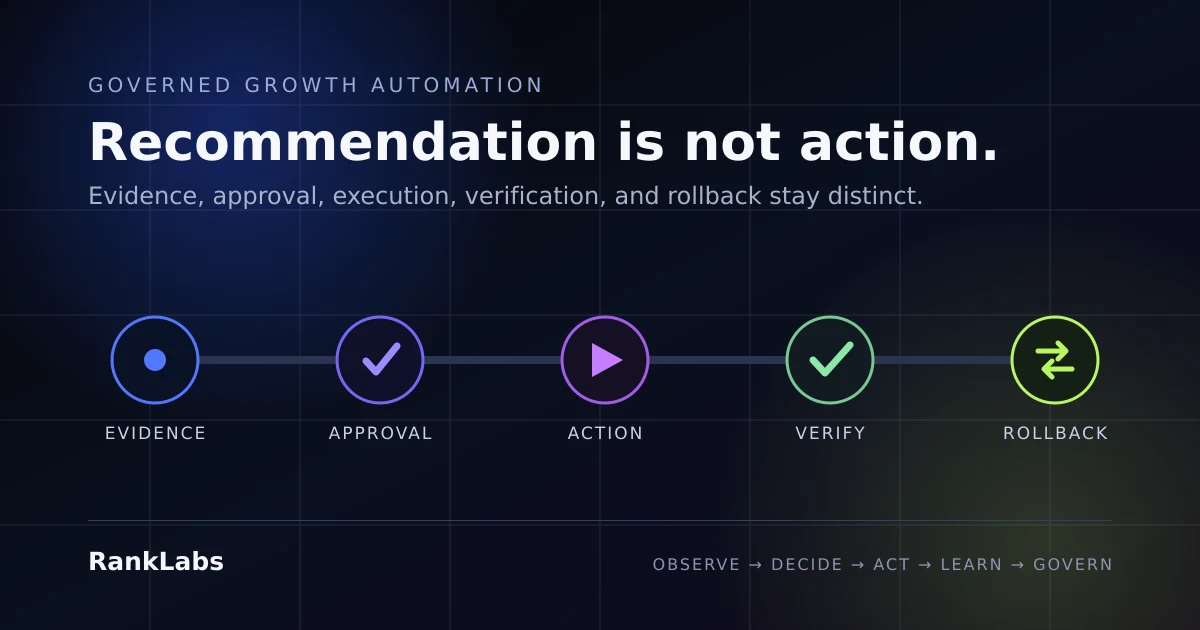
A recommendation describes what may be worth doing. An action record proves what was authorized, attempted, verified, and reversed. Growth automation becomes defensible only when those states remain separate.
Current RankLabs boundary: RankLabs supports public-web and enabled AI-provider observations, deterministic diagnostics, evidence-linked findings, and governed recommendations within supported scope. Customer activation and autonomous external execution are not currently announced as available.
Platform direction: Approved, bounded, reversible actions are part of the Automated Growth Intelligence operating model, but they require separate implementation, policy, activation, and production authority.
This separation sits at the center of the Automated Growth Intelligence loop:
Observe → Resolve → Explain → Decide → Act → Learn → Govern
One recommendation, five different records
Return to the availability example. A diagnostic may show that a product page conflicts with an approved catalog source. The system may recommend correcting the public representation.
That sentence does not prove that a person approved the recommendation, that an operation occurred, or that the intended state exists.
A reviewable workflow preserves five different records:
| Record | Question answered | What it does not prove |
|---|---|---|
| Finding | What evidence-supported issue was observed? | That the proposed fix is correct |
| Recommendation | What bounded next step is proposed? | That a person or policy approved it |
| Decision | Who approved, rejected, deferred, or requested evidence? | That an external action occurred |
| Action attempt | What exact operation ran under which authority? | That the intended state was achieved |
| Verification and outcome | What state followed, and what evidence supports it? | That the action caused every later result |
Collapsing these records creates false certainty: recommendations appear completed without approval, accepted requests look verified, and later metrics get attributed to actions that never occurred. The remedy is a stronger evidence chain, not more automation.
A recommendation needs an evidence contract
Before entering a decision queue, a recommendation should identify:
- the exact finding and evidence version;
- the affected organization, site, page, product, campaign, or other entity;
- the proposed change and expected mechanism;
- known limitations and alternative explanations;
- required permissions and dependencies;
- expected benefit without inventing unavailable impact;
- risk and reversibility;
- the measurement needed after execution.
A recommendation remains useful when effort, revenue impact, or outcome confidence is unknown. Those dimensions should not be filled with modeled values merely to simplify prioritization.
Evidence, analytical, recommendation, and expected-outcome confidence answer different questions. A strong diagnosis can still support an uncertain intervention.
Approval is an event, not a checkbox
Approval should preserve the authority, time, reviewed evidence, and exact recommendation version.
Decision events can approve, reject, defer, request evidence, supersede, or cancel. Unlike a mutable approved field, immutable events preserve history and rebuild the current state.
Approval should also expire when its assumptions no longer hold. If the target, evidence, credential, recommendation, or policy changed after approval, the system should require reevaluation rather than treating the old decision as permanent authority.
Match approval strength to action risk
Not every action needs the same controls. A governance model can classify work by external effect and reversibility.
| Action class | Example | Minimum governance |
|---|---|---|
| Read only | Display evidence or generate a report | Authorized access and evidence scope |
| Internal workflow | Create a task, alert, or patch export | Named authority and duplicate protection |
| External draft | Create an unpublished draft in an approved sandbox | Owner approval, sandbox proof, and cleanup path |
| Reversible production change | Apply a bounded write that can be restored | Strong approval, cohort limit, verification, and rehearsed rollback |
| High-impact or irreversible change | Broad financial, legal, security, or destructive operation | Prohibited until separate authority and controls exist |
This table describes a governance pattern, not a claim that RankLabs currently executes each class.
Risk-based controls increase safe throughput by separating low-risk work from production changes that require stronger review.
The six action gates
An approved action should pass six gates before it can be treated as complete.
| Gate | Required proof |
|---|---|
| Authority | The exact decision, approver or policy, target, scope, and credential authority |
| Preconditions | The facts that must still be true before execution |
| Safe retries | An idempotency identity that prevents duplicate effects |
| Blast radius | The maximum pages, products, records, spend, or users the action may affect |
| Verification | The authoritative post-action state and method used to inspect it |
| Rollback | The prior state, reversal method, trigger, authority, and accepted limitations |
Recommendation confidence does not create execution authority. Time can also invalidate an approved plan if the target, evidence, policy, or credentials change. Preconditions should stop stale work, and blast-radius limits should stop work that exceeds the approved cohort.
Networks fail and workers restart. An idempotency key prevents retries from creating duplicate effects, but it does not replace verification. A successful request only proves that a system accepted or processed something. Verification must inspect the authoritative result.
Rollback should be designed before a reversible production change. Compensating-only or irreversible effects need explicit policy and stronger authority. If a required gate is missing, the action is not ready or not verified.
Failure and unknown states must remain visible
Automation becomes dangerous when it overwrites failure with the desired final state.
Preserve each attempt as denied, skipped, timed out, partially applied, applied but unverified, verified, rolled back, or rollback failed.
An unknown result is not success or failure. It requires reconciliation.
This matters when a provider times out after receiving a request. The external effect may have occurred even though the caller did not receive confirmation. Retrying without reconciliation can duplicate the effect.
Visible failure supports accountability and recovery. It also prevents operational metrics from counting an unverified attempt as completed work.
Governance enables safe speed
Governance is often described as friction. In a well-designed system, it provides the conditions for faster, safer execution.
It can support:
- faster approval of bounded, low-risk work;
- fewer unauthorized production changes;
- safer retries and recovery;
- clear separation between attempted and verified work;
- reusable policies for repeated action classes.
Teams can evaluate decision latency, precondition failures, verification rates, unknown states, rollbacks, and recovery time. Those operational measures remain separate from business outcomes.
Learning begins after an identifiable intervention
A verified action is still not proof of commercial impact.
Learning requires a defined intervention, affected population, outcome source, comparison strategy, observation window, and known confounders. A before-and-after difference may support investigation, but it does not automatically establish causality.
The chain should remain navigable:
Finding → Recommendation → Decision → Action attempt → Verification → Outcome observation → Learning
If one link is missing, the platform should limit the claim rather than infer the missing event.
AI answer volatility can describe changes in comparable stored observations. AI Revenue Intelligence can add commercial context only when separate source and measurement contracts are satisfied.
Warning signs when evaluating a platform
Look for these governance failures:
- A recommendation is marked “fixed” without an action record.
- Approval is a mutable checkbox with no event history.
- An API success response is treated as verification.
- Retries can create duplicate external effects.
- The action has no explicit tenant or blast-radius boundary.
- Rollback is designed only after execution fails.
- Unknown external state is recorded as success.
- A later metric change is automatically attributed to the action.
A polished workflow cannot compensate for a missing evidence chain.
What this means for RankLabs today
Presence Manager keeps observations and recommendations conceptually separate:
- View supports inspection of stored observations, citations, and evidence.
- Manage organizes supported gaps, recommendations, limitations, and measurement requirements.
Manage does not imply that RankLabs executed an external change. Customer activation remains withheld pending separate action authority, policy, implementation, verification, and rollback controls.
Frequently asked questions
Is a recommendation an action?
No. A recommendation proposes a bounded next step and preserves its evidence and limitations. An action requires a separate decision, authority, execution attempt, and verification record.
Does approval mean an action can run indefinitely?
No. Approval should bind an exact recommendation, policy, target, scope, and time window. Changed assumptions or expired authority should require reevaluation.
Can low-risk actions run under policy authority?
A governance model may permit narrowly defined low-risk work under explicit, versioned policy authority. The policy must still enforce tenant scope, preconditions, duplicate protection, verification, limits, and revocation. This is a design pattern, not a claim of current RankLabs customer activation.
Must every action support rollback?
Every reversible production action should have a tested rollback plan. Irreversible or compensating-only effects require explicit policy, stronger approval, and accepted limits before execution.
Does a verified action prove business impact?
No. Verification proves the intended external state was observed. Business impact requires a separate outcome source, population, window, comparison method, and uncertainty assessment.
The practical conclusion
Governance should enable safe speed without losing evidence, authority, or accountability.
A finding is not a recommendation. A recommendation is not a decision. A decision is not an action. An action is not an outcome.
Preserve those boundaries, and automation can become safer, more explainable, and more useful. Collapse them, and the system can manufacture a success story from events that never happened.